Successful Qualitative Research by Virginia Braun & Victoria Clarke
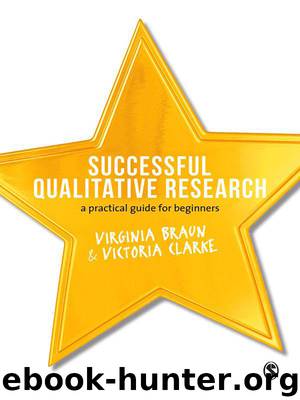
Author:Virginia Braun & Victoria Clarke [Braun, Virginia]
Language: eng
Format: epub
ISBN: 9781446289518
Publisher: SAGE Publications
Published: 2013-03-21T16:00:00+00:00
VARIATION 2: INTERPRETATIVE REPERTOIRES
DA which explores interpretative repertoires also looks at patterned meanings, but it draws on an intellectual tradition far wider than, but including, poststructuralism, such as ethnomethodology (Garfinkel, 1967), conversation analysis (Sacks, 1992) and the sociology of scientific knowledge (and more; see Potter & Wetherell, 1987). The idea of an interpretative repertoire was first articulated by the British sociologists Nigel Gilbert and Michael Mulkay in a book examining the way scientists talked about science (Gilbert & Mulkay, 1984). It became a cornerstone concept for the version of DA introduced by British/New Zealand psychologists Jonathan Potter and Margaret Wetherell (1987) in Discourse and Social Psychology. Interpretative repertoires have been defined as ‘relatively coherent ways of talking about objects and events in the world’ (Edley, 2001a: 198). This definition bears similarity to the idea of a ‘discourse’ discussed above (but see Burr, 1995), and was indeed developed to capture the systems of meaning that people live within, and draw on as collectively available resources in their use of language (Potter & Wetherell, 1995; Potter, Wetherell, Gill, & Edwards, 1990). British psychologist Nigel Edley describes repertoires as like books in a library, endlessly available for borrowing. Repertoires can be seen as smaller and ‘less monolithic’ than discourses, more specific and fragmented, and potentially diverse (Edley, 2001a). Discourses could be seen as akin to an edge-of-town mega-store, like an IKEA, and repertoires more like smaller high-street stores. The difference between repertoires and discourses is, however, also theoretical, and Edley describes it as signalling the broader ‘conceptual and methodological positions’ (Edley, 2001a: 202) of DA work: talking about ‘repertoires’ or ‘discourses’ is a shorthand for your theoretical positions and your analytic take on the data.
Analysis within this tradition is not just interested in looking at talk to identify what resources – repertoires – are used; like poststructuralist discourse analysis, it goes further, but in almost the opposite direction. Although they share an agenda in considering what identified repertories (discourses) tell us about the world, this approach is interested in how repertoires are put together and deployed in specific (‘local’) contexts, and in the effects they have at that level, in terms of the versions of realities and identities (among other things) that they construct. But where poststructuralist DA includes an interior orientation (through being interested in how the person can experience themselves, their desires, etc.), this DA approach keeps it fully exterior (e.g. looks at how identities are constructed and produced ‘for others’, and for contexts). Poststructuralist DA can be seen as interested (in part) in a ‘person who is spoken into being’ through discourse (a person conceptualised as ‘used’ by discourse; Potter et al., 1990); repertoire analysis is interested in the reality a speaking person creates (a person conceptualised as a user of discourse; Potter et al., 1990). So the person is theorised as a more agentic user of language and discourse than in poststructuralist approaches (this aspect has been emphasised in the development of this approach into DP – see Box 8.
Download
This site does not store any files on its server. We only index and link to content provided by other sites. Please contact the content providers to delete copyright contents if any and email us, we'll remove relevant links or contents immediately.
| Anthropology | Archaeology |
| Philosophy | Politics & Government |
| Social Sciences | Sociology |
| Women's Studies |
Cecilia; Or, Memoirs of an Heiress — Volume 1 by Fanny Burney(32563)
The Great Music City by Andrea Baker(32024)
Cecilia; Or, Memoirs of an Heiress — Volume 2 by Fanny Burney(31962)
Cecilia; Or, Memoirs of an Heiress — Volume 3 by Fanny Burney(31945)
We're Going to Need More Wine by Gabrielle Union(19055)
All the Missing Girls by Megan Miranda(16053)
Pimp by Iceberg Slim(14523)
For the Love of Europe by Rick Steves(14177)
Bombshells: Glamour Girls of a Lifetime by Sullivan Steve(14081)
Norse Mythology by Gaiman Neil(13379)
Talking to Strangers by Malcolm Gladwell(13376)
Fifty Shades Freed by E L James(13247)
Mindhunter: Inside the FBI's Elite Serial Crime Unit by John E. Douglas & Mark Olshaker(9350)
Crazy Rich Asians by Kevin Kwan(9297)
The Lost Art of Listening by Michael P. Nichols(7510)
Enlightenment Now: The Case for Reason, Science, Humanism, and Progress by Steven Pinker(7316)
The Four Agreements by Don Miguel Ruiz(6770)
Bad Blood by John Carreyrou(6626)
Weapons of Math Destruction by Cathy O'Neil(6285)
